Monitoring, Evaluation, Accountability & Learning
Evidence your board, your donor and the village can all trust.
We design and run studies that show what changed, for whom, and why. Our field teams speak the local languages; our analysts write findings that people read past the executive summary.
Who it’s for
- Corporates & CSR
- NGOs
- Philanthropies
- Government programmes
- Development projects
How we engage
Single studies, or a baseline-midline-endline series with the same team, so indicators and samples stay comparable.
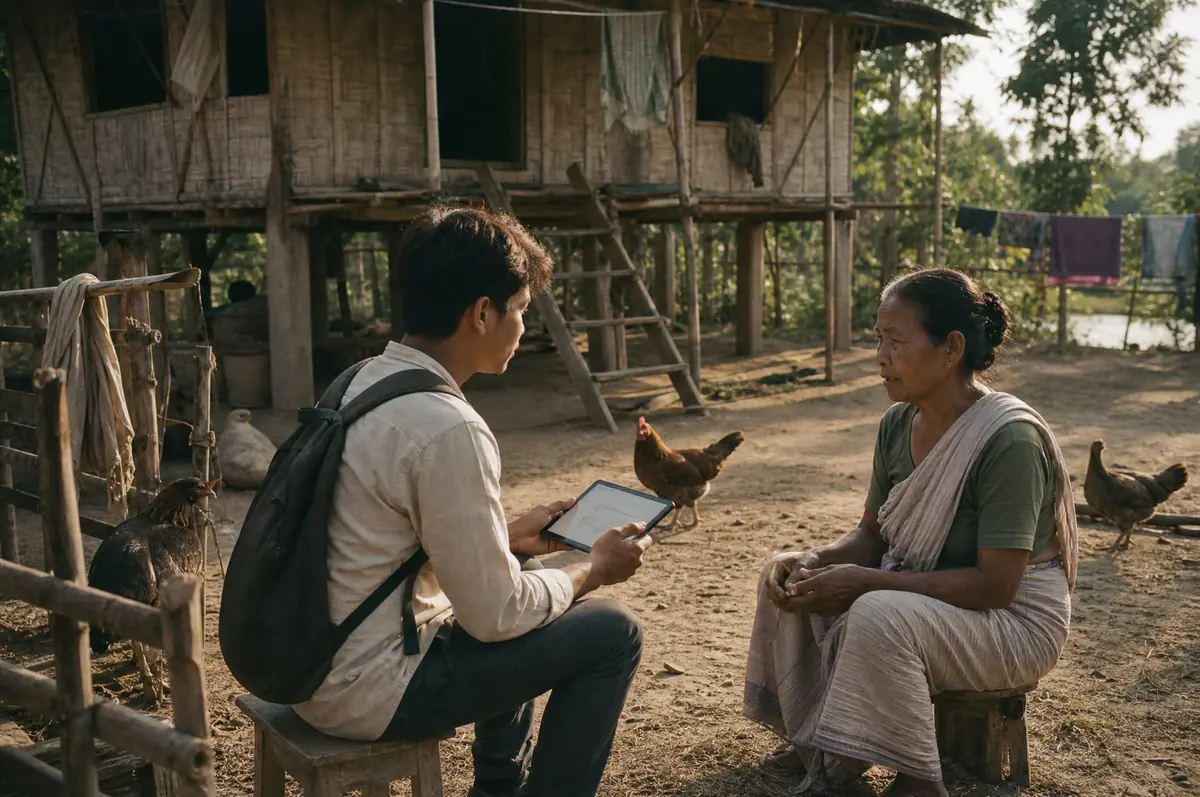
Seven kinds of study, matched to the moment.
Take the full service or only the pieces you need. Every item below can be scoped as a stand-alone assignment.
| Study | When to use it | Typical methods | Duration |
|---|---|---|---|
| Baseline assessment | Before the first rupee is spent. Sets the benchmark that every later claim depends on. | Household survey (CAPI), FGDs, KIIs, pond and plot measurement | 6-10 weeks |
| Participatory Rural Appraisal | When the community should shape the design, not just receive it. | Resource and social mapping, seasonal calendars, wealth ranking, transect walks | 2-4 weeks |
| Rapid Rural Appraisal | When you need a reliable picture quickly: after a flood, or before a proposal deadline. | Semi-structured interviews, direct observation, secondary data | 1-3 weeks |
| Midline assessment | Halfway through, while there is still time to change course. | Panel follow-up of baseline sample, process review | 6-8 weeks |
| Endline & impact studies | At close, to show what changed and how much of it the programme can claim. | Quasi-experimental designs (difference-in-differences, matching), mixed methods | 8-14 weeks |
| Sustainability assessment | Will the results last once funding stops? Institutional, financial and environmental tests. | Institutional scoring, financial health checks, environmental indicators | 4-8 weeks |
| Feasibility assessment | Before capital is committed: technical, market, financial and social viability. | Market study, site assessment, financial modelling, risk analysis | 4-10 weeks |
Accountability
Community feedback and grievance systems, beneficiary verification and social audits that give participants a real voice.
Learning
Four-page learning briefs, reflection workshops with field staff, and dashboards that programme teams check every month.
Ethics
Informed consent, gender-matched enumerators, and data handling in line with India’s Digital Personal Data Protection Act, 2023.
Four steps, no surprises.
Inception
Agree the questions, indicators, sample and ethics before anyone goes to the field.
Tools & training
Build digital tools, pilot them, and train enumerators in the local language.
Field work
Supervised data collection with daily quality checks and back-checks.
Analysis & learning
Analysis, report, learning brief and a session with your team on what to do next.
What you receive
- Inception report and tools
- Clean datasets with codebooks
- Programme dashboard
- Full report
- Four-page learning brief
- Findings workshop
What clients usually ask.
Something else? Call +91 93653 40780.
Can you work in remote or flood-affected areas?
Yes. Much of our field work is in char, riverine and hill areas of the Northeast. We plan around seasons and local festivals and build contingency days into every schedule.
Do you share raw data?
Yes. Clients receive cleaned, anonymised datasets with codebooks and analysis scripts, unless the agreement with respondents says otherwise.
How large a sample can you handle?
We have run surveys from a few hundred to several thousand households, across multiple districts and languages, with supervision at every stage.
Can you evaluate programmes outside the Northeast?
Yes. We work across India and partner with local field teams where language or logistics require it.